
Weekly Analysis: Editorial Team
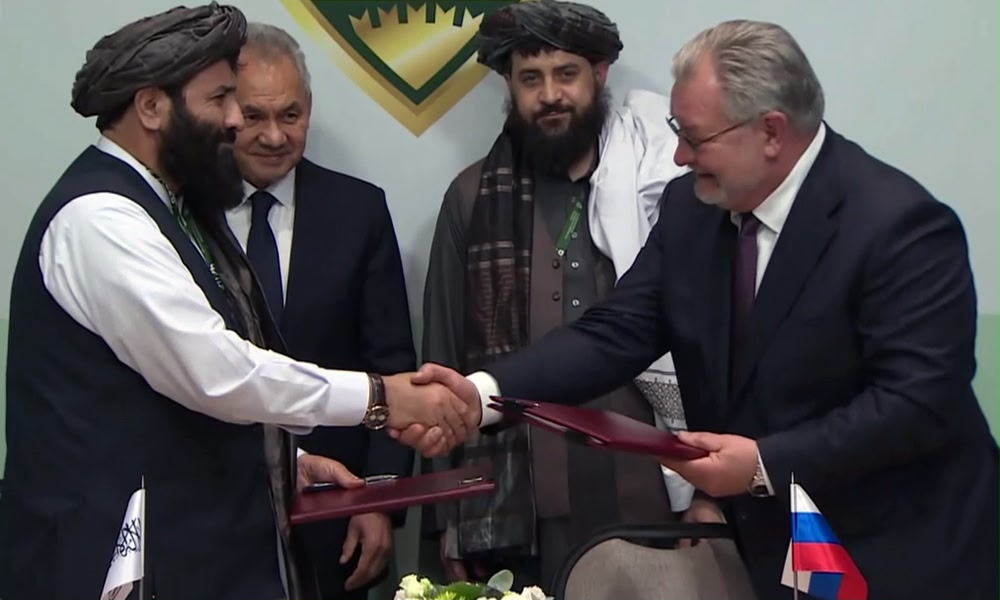
The ongoing discussion about Afghanistan’s recent defense and security agreement with Russia reveals a lot about how some people still perceive international politics, just as much as it sheds light on the agreement itself. Too frequently, foreign policy is viewed through the lens of the idea that engaging with one nation must mean sacrificing relations with another. However, the world we live in today is no longer neatly divided into rigid factions and exclusive alliances. Instead, it’s increasingly shaped by various power centers, growing regional interdependence, and countries striving for more flexibility in pursuing their national interests.
This reality is especially significant for Afghanistan.
Positioned at the intersection of Central Asia, South Asia, the Middle East, and the wider Eurasian region, Afghanistan has historically been swayed by the ambitions and rivalries of larger powers. But geography doesn’t have to be a weakness; if managed wisely, it can turn into a strategic advantage. In this age of multipolarity and renewed regionalism, Afghanistan’s location naturally opens the door to partnerships with multiple nations rather than relying on just one.
It’s in this broader context that we should interpret the recent agreement with Russia.
International relations scholars have long maintained that a state’s primary duty is to ensure its survival and security. Kenneth Waltz, a key figure in the field, emphasized that security is the fundamental concern for states navigating an uncertain global landscape. More recently, Amitav Acharya has described a developing “multiplex world,” where power and influence are increasingly spread among various actors rather than being concentrated in a single hub. For countries like Afghanistan, these realities are not just theoretical musings; they have real-world implications for foreign policy.
Afghanistan is currently grappling with a host of challenges. The need for economic recovery, investment, job creation, improved connectivity, and overall development is more pressing than ever. However, history has shown us time and again that lasting prosperity hinges on stability. It's the fundamental duty of every state to safeguard its sovereignty, territorial integrity, and the well-being of its citizens. While security alone doesn't guarantee development, achieving development without security is a tough uphill battle.
From this viewpoint, enhancing defensive capabilities and seeking security partnerships shouldn't be seen as out of the ordinary or provocative. Every sovereign nation has both the right and the duty to ensure it has the necessary means to protect its land, institutions, and people. Defense cooperation doesn't automatically mean military alignment, nor should it be perceived as a threat to others. More often than not, it simply reflects a state's commitment to fulfilling its most essential responsibilities.
This is exactly why the Afghanistan-Russia agreement should be seen as a move towards strategic autonomy rather than just following the crowd. It doesn't indicate that Afghanistan is aligning itself with a geopolitical bloc, nor does it imply a shift away from engaging with other international partners. Instead, it showcases an effort to diversify relationships and broaden strategic options in the pursuit of national interests.
Absolutely, Afghanistan’s foreign policy is already showcasing this approach. While it collaborates with Russia on security issues, Kabul is also ramping up its economic ties with China, enhancing trade relations with India, bolstering energy partnerships with Iran, and striving for better connectivity with Central Asian nations. At the same time, Afghanistan is keen on fostering positive relations with the United States, the United Kingdom, Europe, Japan, the Gulf states, and the broader international community.
These connections aren’t at odds with each other; they actually complement one another.
In today’s world, it’s becoming increasingly common for countries to engage in security cooperation with one partner, economic collaboration with another, and diplomatic ties with several others. For Afghanistan, which has interests that stretch across various regions and whose future success hinges on connectivity and external partnerships, this kind of diversification isn’t just smart—it’s essential.
This reality is further underscored by the rising significance of regional dynamics in global affairs. Scholars like Barry Buzan and Ole Wæver have pointed out that regional factors are playing a bigger role in shaping the security and prosperity of nations. Thus, Afghanistan’s future will rely not only on its interactions with major global powers but also on its capacity to maintain fruitful relationships within its broader neighborhood. A well-rounded foreign policy enables Afghanistan to engage in various regional frameworks without becoming overly reliant on any single player.
The importance of the agreement with Russia isn’t just about Russia itself; it symbolizes a larger strategy of pursuing foreign relations through balance, diversification, and strategic adaptability. This text highlights the idea that Afghanistan's national interests are best served not by isolating itself or aligning exclusively with a single power, but rather by engaging constructively with all parties willing to cooperate based on mutual respect and shared goals.
Afghanistan's unique geography has often been seen as a battleground for competition. However, in the context of the new international landscape, it can actually present opportunities. The real challenge lies not in choosing sides between East and West, or North and South, but in finding ways to involve all these players in a manner that bolsters Afghanistan's sovereignty, security, and prosperity.
There’s a chance that other nations might take inspiration from this agreement and show a greater willingness to form similar partnerships with Afghanistan across various sectors, such as security, economic collaboration, and trade. Up until now, Western nations have mostly lagged behind in this area. This could suggest a waning influence of the West in shaping Afghanistan's future, or it might indicate a strategic oversight that has hindered its ability to engage effectively with the shifting regional and economic landscape.
Given the recent security challenges, Afghanistan seems to recognize an increasing need to bolster its defense capabilities. Since many Afghans perceive Western countries as closely aligned with some of their more assertive neighbors, it’s only natural for Kabul to seek out different ways to enhance its security and defense strategies.
It's important to clarify that Afghanistan isn't necessarily looking to join any specific security bloc or alliance. Instead, this move shows a desire to broaden its options and create practical ways to protect its national interests. In this light, Afghanistan seems poised to engage with a variety of international players, seeking security, economic, and trade partnerships not just with neighboring countries but also with Western nations where shared interests and positive dialogue can flourish.
In a world that’s increasingly shaped by multiple power centers and regional connections, this stance isn’t about being neutral or taking sides. It’s about strategic independence. For Afghanistan, this might just be the most sensible and responsible way to move forward.