
Weekly Analysis: Editorial Team
From Silk Road foundations to future cooperation—an Afghan perspective on a steady and constructive partnership
Afghanistan and China may be connected by just a slender strip of land known as the Wakhan Corridor, but their relationship is surprisingly stable and uncontroversial, especially in a region often marked by rivalry, intervention, and unresolved conflicts. For Afghanistan, this bond is both unique and precious. There’s no history of war between the two nations, no lingering territorial disputes, and no colonial baggage to complicate their interactions. In a neighborhood where mistrust often clouds diplomatic efforts, the relationship between Afghanistan and China has instead flourished through restraint, continuity, and a mutual desire for stability.
This partnership has never been flashy or driven by ideology. It has quietly evolved, shaped more by practical considerations than lofty ambitions. For Afghanistan—whose recent history has been riddled with foreign interventions, shifting alliances, and externally imposed political experiments—this kind of predictability is strategically important. The bottom line is clear: Afghanistan’s ties with China are built on a solid historical foundation and present realistic, forward-looking opportunities, as long as they are pursued with transparency, patience, and a strong focus on Afghan national interests rather than political affiliations.
Afghanistan in Asia’s Economic and Cultural Continuum
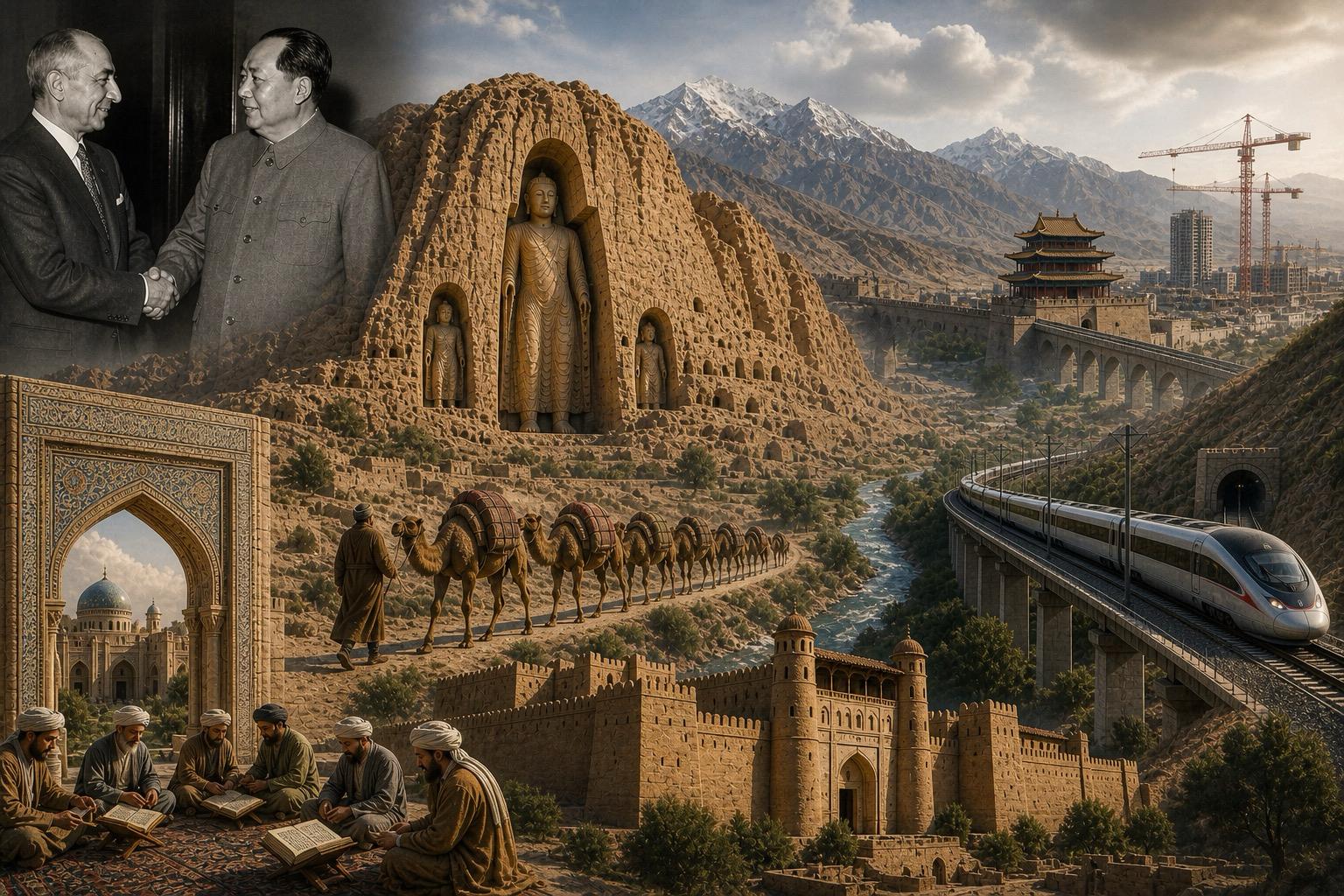
Often seen as isolated or on the fringes, Afghanistan has historically held a central role in Asia’s economic and cultural networks. Long before modern borders were drawn, the trade routes connecting China to Central Asia, South Asia, and the Middle East ran straight through Afghan territory. These corridors not only facilitated the exchange of goods but also allowed for the flow of ideas, technologies, and belief systems over the centuries.
One of the most striking examples of this role is how Buddhism made its way into China via the routes through Central Asia and Afghanistan. Monks, traders, and scholars journeyed across these regions, transforming Afghanistan into a vibrant center of cultural exchange rather than just a battleground. This historical context is important because it shows us that the current engagement between Afghanistan and China isn’t just a random geopolitical move. It’s rooted in a deeper economic and geographical reality that has shaped Asia for ages, where connections developed naturally from shared interests and closeness.
Recognizing this continuity helps Afghanistan approach its modern relationships with a sense of assurance instead of doubt. Working with China doesn’t mean turning its back on other partners or falling into a new dependency. Rather, it signifies a return to long-established regional dynamics, handled in a contemporary and thoughtful way.
The Wakhan Corridor: Choosing Caution Over Conflict
The Wakhan Corridor stands out as one of Asia’s most peaceful and least militarized borders. It’s remote, environmentally delicate, and sparsely populated, embodying a tradition of restraint instead of aggression. The 1963 Afghanistan–China Boundary Agreement is a rare instance of successful diplomacy in a sensitive area, settling border disputes without conflict or lengthy arguments.
Wakhan is often mentioned as a potential shortcut to East Asia or an exciting gateway for regional trade. While this interest is certainly valid, it’s crucial to keep expectations grounded. From Afghanistan’s policy viewpoint, Wakhan offers long-term strategic benefits for selective connectivity, tourism, and specialized trade. However, it also faces significant challenges: tough terrain, severe weather, high construction expenses, and environmental sensitivity.
Taking a patient approach is key here. We should view Wakhan as a long-term strategic option instead of a quick fix for economic issues.
Staying Steady in Uncertain Times
Formal diplomatic ties between Afghanistan and China kicked off in 1955, during a time when many Asian nations were reshaping themselves after colonialism. Since then, Afghanistan has faced years of conflict, changes in government, and the breakdown of institutions. On the other hand, China has kept a mostly steady stance towards Afghanistan, focusing on sovereignty, territorial integrity, and a hands-off approach.
This consistency has influenced how Afghans view their relationships. In a world where unpredictability and conditional partnerships are the norm, having a steady hand is a valuable asset. Afghan foreign policy is increasingly leaning towards partners who don’t make sudden changes, impose ideological pressures, or engage in experimental interventions.While China’s approach may not be expansive or interventionist, it has certainly been reliable—and for Afghanistan, that reliability holds significant strategic importance.
The Current Moment: Engagement Without Illusion
China is currently treading carefully in its dealings with Afghanistan, taking a step-by-step approach. Beijing is primarily focused on security and limited economic opportunities rather than diving into large-scale investments.On the flip side, Afghanistan is looking for ways to normalize its economy and integrate regionally without getting tied down to exclusive alliances or political blocs.
From Kabul’s viewpoint, the focus is on practical matters: jobs, exports, investment, and connectivity. Engaging with China doesn’t mean becoming dependent, nor does it rule out building relationships with other regional or global players. Keeping options open is crucial for managing risks.This phase is all about being pragmatic rather than polarized.
China’s main worry is security, especially concerning stability in Xinjiang and the potential threats from Uyghur-linked groups like the East Turkestan Islamic Movement (ETIM). Historically, Afghanistan hasn’t been a base for actions against China. Even though there were initial concerns after the political shift in Kabul, those fears haven’t really come to pass. Chinese investors in Afghanistan have faced relatively few security issues, even when security measures weren’t consistently enforced. This indicates a security landscape that can be navigated with caution.
However, investment has turned out to be a trickier affair. There was a wave of optimism that attracted many Chinese companies to Afghanistan, but challenges like poor coordination, regulatory gaps, and varying levels of technical expertise have held back progress. Some firms didn’t meet the expected standards, resulting in underwhelming projects and damage to their reputations.
In this context, it’s important to distinguish between companies. Major players like the Metallurgical Corporation of China (MCC), which is involved in the Mes Aynak copper project, have shown a higher level of professionalism and commitment to international standards.
MCC’s plan to engage in underground mining—approved by Afghan authorities—highlights how responsible investment can strike a balance between economic goals and the preservation of cultural heritage. For Afghanistan to achieve sustainability, it needs to implement quality standards, facilitate skills transfer, and ensure that value-added processing happens within its own borders. These principles resonate with China’s “win-win” approach and are crucial for fostering trust and credibility.
Where Pragmatism Meets Opportunity
If handled with care, economic cooperation could unlock significant potential. Afghanistan has a wealth of competitive agricultural exports—like dried fruits, nuts, saffron, carpets, and medicinal herbs—that could tap into China’s enormous consumer market. However, success hinges on tangible improvements in standards, logistics, customs processes, and banking systems.
While mining offers opportunities, it also comes with its share of risks. The case of Mes Aynak shows that mere interest in investment isn’t enough. To effectively develop resources, there must be security, solid infrastructure, clear regulations, and a commitment to respecting cultural heritage. Afghan stakeholders are increasingly prioritizing transparency, local job creation, environmental protections, and meaningful development outcomes over simple extraction deals.
Connectivity projects also require a realistic approach. Afghanistan’s true value lies not just in being a transit point, but in evolving into a regional hub that creates domestic value. Collaborations with regional initiatives should be driven by economic sense rather than mere symbolism.
Mutual Expectations Between China and Afghanistan
China's expectations hinge on three main pillars: security guarantees, economic collaboration, and regional stability. Beijing wants to be assured that Afghan territory won't pose any security risks, while also seeing Afghanistan as a potential hub for broader regional connectivity, especially in relation to the Belt and Road Initiative.
On the flip side, Afghanistan has its own clear expectations. Kabul is looking for respect for its sovereignty, non-interference, and engagement that doesn't involve outside mediation. There are ongoing concerns that Pakistan's influence might be shaping China's Afghan policy, whether that's true or not. Tackling this perception is crucial for building trust.
Economically, Afghanistan is counting on China for investments that will boost local processing, facilitate skills transfer, and create jobs. The Wakhan Corridor is seen as a sovereign and balanced route that aligns with Afghanistan's national priorities.
A Future Built on Quiet Strength
Afghanistan isn’t looking for exceptionalism or to rely on others; it simply wants to build normal, dignified, and mutually beneficial relationships with its neighbors. When we look at China’s role, it makes the most sense to see it as a stable neighbor, a valuable market, and a partner with a solid track record.
The historical conflicts Afghanistan has faced with Britain, the Soviet Union, and the United States weren’t just about geopolitics; they were also about ideological imposition and meddling in its social fabric. China’s focus on non-interference and economic collaboration resonates more with Afghanistan’s historical sensitivities.
If approached with patience, transparency, and mutual respect, the relationship between Afghanistan and China could blossom into one of Asia’s most understated yet constructive partnerships. In a region often marked by noise and conflict, it’s this quiet strength that might just turn out to be the most enduring foundation of all.