
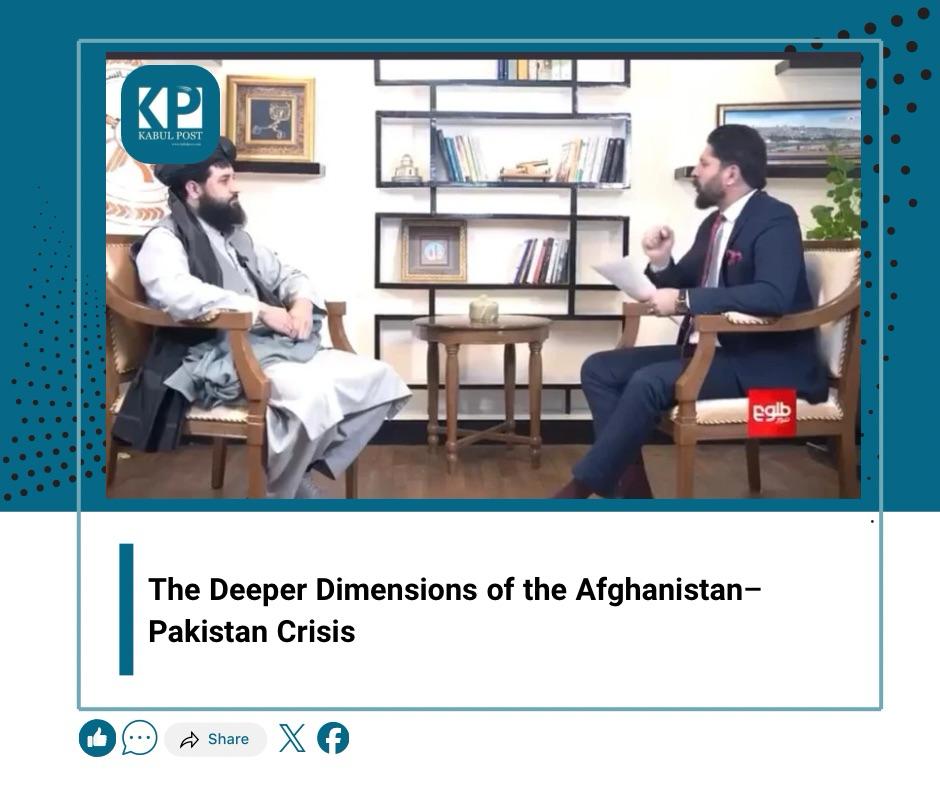
In a recent interview with TOLOnews, Mawlawi Mohammad Yaqoob Mujahid, the Minister of National Defense for the Islamic Emirate of Afghanistan, shared some critical insights about the ongoing political and security tensions between Afghanistan and Pakistan. He delved into the root causes of the issues plaguing their relationship, making it clear that the current regional strains go beyond simple border disputes. Instead, they reflect a complex web of strategic calculations and political pressures.
One of the major bottlenecks in these bilateral disputes is Pakistan’s insistence on what it considers an official border. Islamabad is forcing to have the Durand Line recognized as an international boundary, but many Afghans view this line as a remnant of colonialism and do not accept it as a legitimate border. This issue transcends geography; it’s deeply intertwined with national identity and historical rights. Mujahid stressed that resolving the matter of the Durand Line isn’t something manageable solely by governments; it ultimately hinges on the will and consensus of the Afghan people.
Another important topic he touched on was Pakistan’s efforts to sway Afghanistan’s foreign policy. Afghan officials have pointed out that Islamabad aims to keep Kabul aligned with its own regional goals, which limits Afghanistan’s ability to pursue an independent foreign policy. This has been a longstanding concern for Afghan governments, as they strive to establish their external relations based on national interests rather than submitting to pressure from neighboring countries.
In the realm of security, Pakistan often asserts that members of Tehrik-i-Taliban Pakistan (TTP) are operating from Afghanistan, claiming that attacks within Pakistan are launched from Afghan soil. However, Afghan officials strongly deny these accusations, suggesting that Pakistan has used them as a justification for military actions within Afghanistan. They argue that these strikes have primarily led to civilian casualties and have severely damaged the country’s essential infrastructure. Such actions, they contend, go against international norms and the core principles of state sovereignty.
Moreover, Pakistan has employed economic and humanitarian measures as a means of political leverage. Trade routes between the two nations are frequently shut down, and Afghan refugees living in Pakistan often find themselves under various pressures. Mawlawi Mohammad Yaqoob Mujahid noted that these tactics tend to escalate whenever political tensions rise between Afghanistan and Pakistan. These policies not only inflict economic damage but also erode the trust that is crucial for both countries.
On the flip side, Afghan officials believe that Pakistan’s military pressure is a strategic blunder. History shows that Afghans have engaged in long struggles against some of the world’s most powerful nations and have never backed down in their fight for independence. Consequently, many Afghans feel that coercive tactics will not solve the issues at hand but will only exacerbate the crisis.
A key point in this discussion is that Afghans do not hold animosity toward the Pakistani people. Numerous Afghan political leaders stress that their conflict is not with the general public of Pakistan but rather with the military and security apparatus that wields considerable influence over the country’s regional strategies. They argue that such entities sometimes contribute to instability as part of larger regional rivalries and global strategic contests.
At the same time, Pakistan’s recent military actions on Afghan soil have sparked a significant political shift: they’ve actually bolstered a sense of national unity within Afghanistan. Even those political groups and figures who typically oppose the Islamic Emirate are rallying behind its stance against outside aggression. This shows that the concepts of national sovereignty and territorial integrity resonate deeply, cutting across the usual political divides among Afghans.
Amid all this strain, Mujahid emphasized that Afghanistan isn’t looking for war. He pointed out that Kabul favors dialogue, understanding, and negotiations as the way to settle disputes. This approach is also seen as crucial for regional stability, since war would bring severe economic and security repercussions for both nations.
Lastly, the wider strategic landscape of the region plays a role in this crisis. Some analysts argue that for the last forty years, Pakistan has leveraged terrorism as a tool in its foreign policy. With the situation in the Middle East growing more complicated, there are worries that Pakistan might try to redirect regional conflicts toward South Asia. Such a move could pose a serious threat and lead to instability throughout the region.
Thus, achieving stability in South Asia hinges on regional cooperation, confidence-building measures, and policies rooted in mutual respect—rather than resorting to war and military aggression.